Dami Tamburini Foundation
The HummingbirdThe Dami Tamburini Foundation is a Florence-based institution dedicated to twentieth-century iconography and the collection of private photographic archives and related visual materials. Its importance in Marco Carrera’s story lies in the transfer of his mother Letizia Calabrò’s archive: an act that preserves her work, confronts his difficult feelings about the family record, and allows the house in Piazza Savonarola to be put up for sale without simply abandoning what it contains.
Purpose and Collections
The Foundation collects private photographic archives as well as posters, postcards, and other materials connected with twentieth-century art and visual culture. It is associated with a small family bank controlled by Luigi Dami Tamburini, though Dami tells Marco that he does not personally run the Foundation. Its remit gives a potential institutional home to Letizia Calabrò’s photographs, which document not merely individual sitters but a wide artistic and architectural world.
Marco discovers the Foundation through Dami, a Sienese heir whose family interests include property, Brunello di Montalcino production, a mineral-water source on Mount Amiata, and the family bank. The Foundation is based in Florence rather than Siena. That local presence makes it a practical destination for the archive stored in the family house at Piazza Savonarola.
Marco’s Route to the Donation
Marco’s connection with Dami begins on the tennis court. At a charity doubles tournament organized during Pitti Uomo week, partners are drawn for each round. Marco and Dami are paired in the semifinal and win despite Dami’s repeated double faults; they then win the final together. Grateful for the victories, Dami invites Marco to dinner at his villa in Vico Alto, near Siena. As their tennis partnership continues, the dinners become more regular.
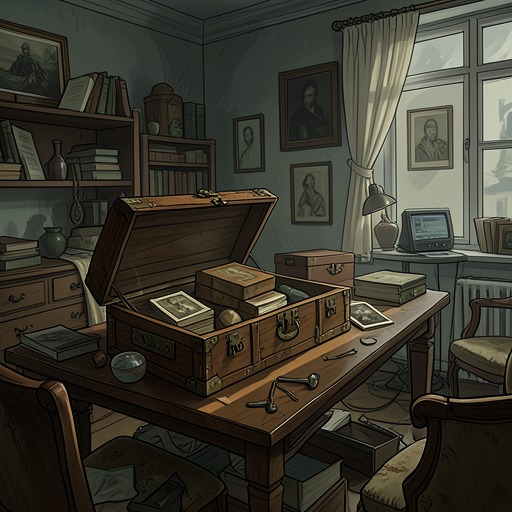
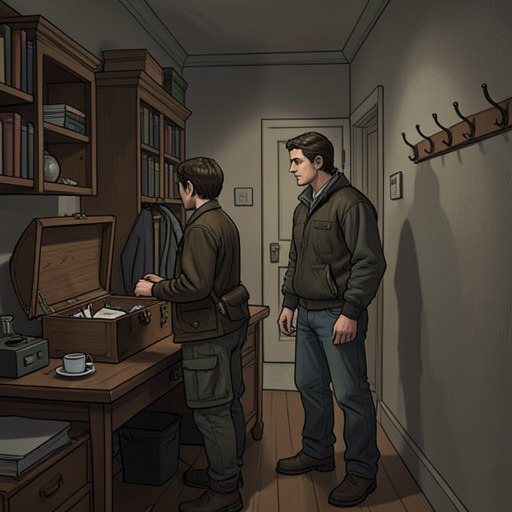
At one of these dinners, Dami describes the Foundation’s collecting work. Marco mentions his mother’s archive almost tentatively, and Dami arranges for him to speak with the Foundation’s president. The president promptly sets an appointment for the next day. Marco takes him to the house in Piazza Savonarola, where the material is still in the disordered state in which Letizia left it.
The encounter changes Marco’s relation to the photographs. He says that for a long time he had avoided handling them: their beauty embarrassed him, and looking at the artists and architects around his mother made him wonder about her private life. More painfully, the images seemed to contain an entire world in which his father, Probo Carrera, had no place. Probo’s own collections and projects had excluded Letizia in their turn, but they presented a solitary world, whereas her photographs showed people, art, architecture, objects, music, landscapes, and social life. Marco recognizes his jealousy as part of what had kept him from examining the archive.
The Archive and Its Transfer
Once he begins looking closely, Marco sees the archive’s documentary breadth. It includes hundreds of black-and-white portraits of architects, designers, and artists, and a substantial section devoted to women architects—nearly complete by Italian standards. Other sequences follow plastic objects such as lamps, chairs, and tables from studio design through factory extrusion. The collection also documents exhibitions by radical architecture groups in the 1960s and 1970s, events in visual poetry, and the 1966 Florence flood.
One photograph in the flood section carries a particular family significance. Among the mud angels outside the National Library, only one image shows Probo: wearing boots and a cape, he stands beneath a lamp, smiling with a cigarette between his lips. For Marco, this single trace of his father in the archive accumulated by his mother makes their birth together seem almost miraculous. The Foundation therefore receives not a neutral body of pictures but a record that alters how Marco reads both parents: Letizia’s expansive professional and social world contains the one surviving image of Probo within it.
The Foundation’s president offers Marco twenty thousand euros for the material. Marco refuses payment and insists that it is a donation, describing the institution’s willingness to take the collection as a favor to him. He suspects the president is assessing whether he is sincere and whether he might be drawn into questionable dealings; he also suspects that Dami has encouraged the president to accept the archive. Those suspicions remain Marco’s interpretation rather than established fact, but they sharpen the meaning of his refusal: he will not turn his mother’s work into a transaction for personal gain.
Preservation and Narrative Significance
The donation is recorded as the Letizia Calabrò donation to the Dami Tamburini Foundation. It ensures, in Marco’s understanding, that the signs of his mother’s passage through the world will not disappear. At the same time, the transfer resolves a practical family problem: the house in Piazza Savonarola can officially be offered for sale. The real-estate market has collapsed after the subprime crisis, and Marco is unwilling to accept a poor price; he can wait rather than sell the house off cheaply.
The Foundation thus stands at the meeting point of preservation and relinquishment. Marco can let go of the house without treating the archive as disposable, and he can face the photographs without pretending that his mother’s world was emotionally simple for him. The images become both a historical collection and a corrective to his family’s partial memories: they preserve Letizia’s work, disclose the world from which Probo was largely absent, and unexpectedly keep one small image of him within that world.